

 ISSN: 1323-8930
Volume 74, Issue 4 (October 2025)
Editor's Choice
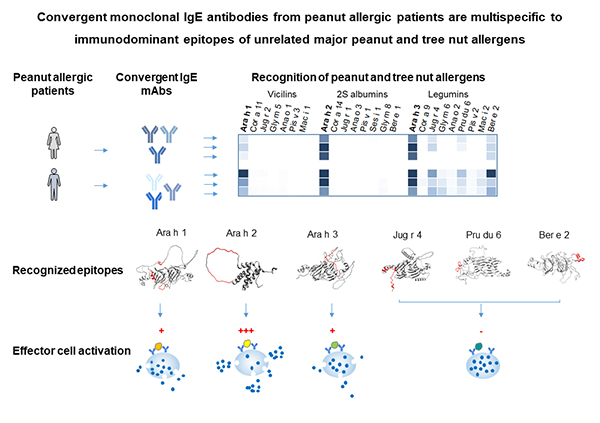
Editor’s comment: Peanut allergy, affecting about 2% of the Western population, is often severe and lifelong. Ara h 2 is recognized as the dominant allergen, eliciting strong IgE-mediated effector cell activation at very low doses. In peanut-allergic patients, sensitization to tree nuts is frequently detected. However, clinical reactivity is less common and unpredictable, and the molecular basis of such co-sensitization is not fully understood. Kabasser et al. (Vienna, Austria) investigated a convergent family of monoclonal IgE antibodies frequently identified in peanut-allergic patients that targets the Ara h 2 DPYSPS motif. The authors examined somatic hypermutation-driven cross-reactivity of the convergent monoclonal IgE antibodies with Ara h 1, Ara h 3, and legumins from selected tree nuts, assessing their capacity to activate effector cells. These findings provide new molecular insight into cross-reactivity, co-sensitization, and allergy severity.
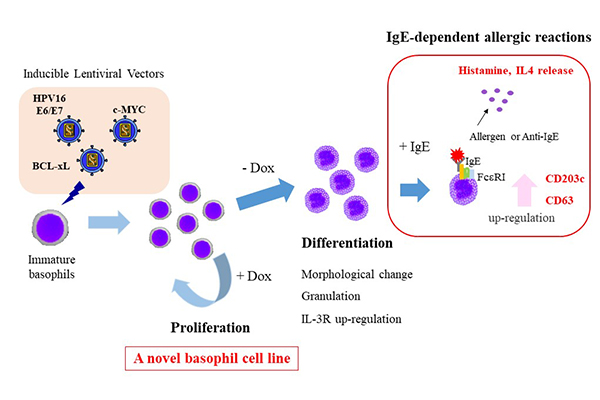
Editor’s comment: Basophils play key roles in allergic inflammation and parasite defense, yet their rarity and short lifespan limit mechanistic studies. Existing tools such as KU812 cells lack sufficient FcεRIα expression, histamine content, and functional stability. To overcome these barriers, Kurita et al. (Kyoto, Japan) established a novel immortalized human basophil cell line, ImBaso-2, from CD34⁺ progenitors using HPV16 E6/E7, c-MYC, and BCL-xL. ImBaso-2 resembles blood baspohils in that it expresses major basophil markers, forms granules, and exhibits IgE- and IL-33–induced histamine and IL-4 release,. This stable, expandable cell line provides a valuable tool for allergy research and allergenicity testing.
